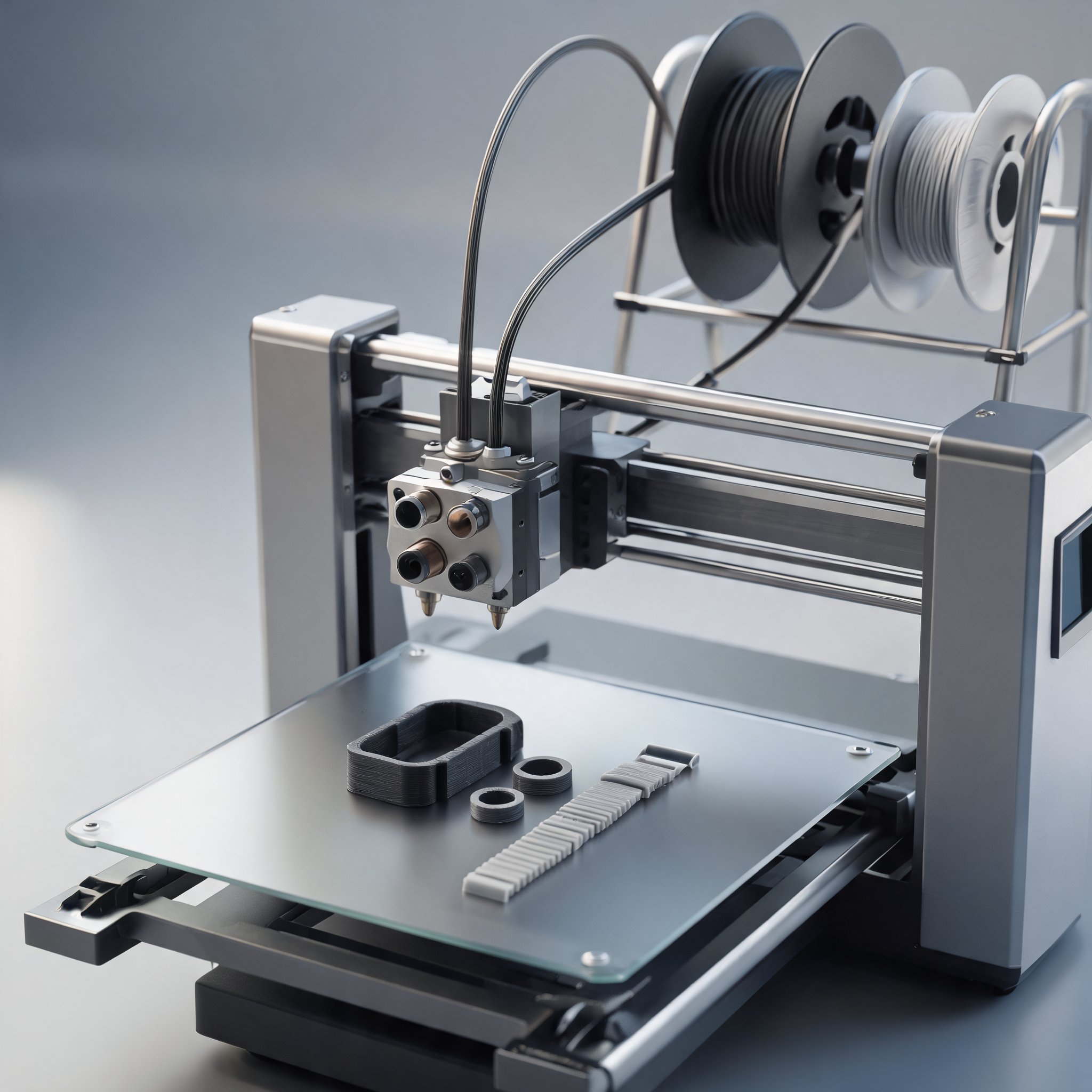
Bambu is revealing details of its forthcoming H3C 3D printer one feature at a time, and the latest teaser shifts from color to materials. After an earlier hint at multi-color printing, the company has published an image of a multi-component watch that assigns different nozzle and filament sizes to different parts of the same build.
According to the teaser, the watch's rigid case is printed with a 0.4 mm nozzle using 1.75 mm filament, the crisp detail work uses a 0.2 mm nozzle with 1.75 mm filament, and the soft strap — identified tentatively by the source as TPU — is printed with a 0.4 mm nozzle fed with 2.85 mm filament.
Two claims behind the image
The teaser supports two readings. First, Bambu appears to be adding 2.85 mm filament compatibility, aimed at soft and rubbery materials such as TPU. Second, and more consequential for existing owners, the image implies that 0.2 mm and 0.4 mm nozzles can be used within a single print.
That combination has been a long-standing request from users of Bambu's H2D and H2C machines, and likely from owners of the more recent X2D as well. Based on what the source has observed, Bambu's software does not currently permit a 0.4 mm and a 0.2 mm nozzle to be mixed in one job; users select a single nozzle. The teaser suggests a print — presumably a multi-object job — can now combine several nozzle and filament sizes. Software limitations are what have blocked the capability on Bambu's existing dual-nozzle printers.
Scope remains an open question
It is not yet clear whether mixed nozzle sizes will arrive on all compatible Bambu printers or only on the upcoming flagship H3C and the smaller P3C. The answer turns on whether Bambu wants the feature to drive sales of new machines or to bring existing customers capabilities they arguably should already have had.
The P3C has not been formally announced; only the H3C has. The source sees no reason the smaller-format model would not carry the same multi-nozzle and filament-size compatibility.
Bambu has not disclosed pricing, a launch date or a full specification for the H3C. In an update, the source notes that a teaser video shows watch components being printed in place as a single part using multiple nozzle and filament sizes — a stronger demonstration than a still image, though still a promotional one rather than an independently verified print.